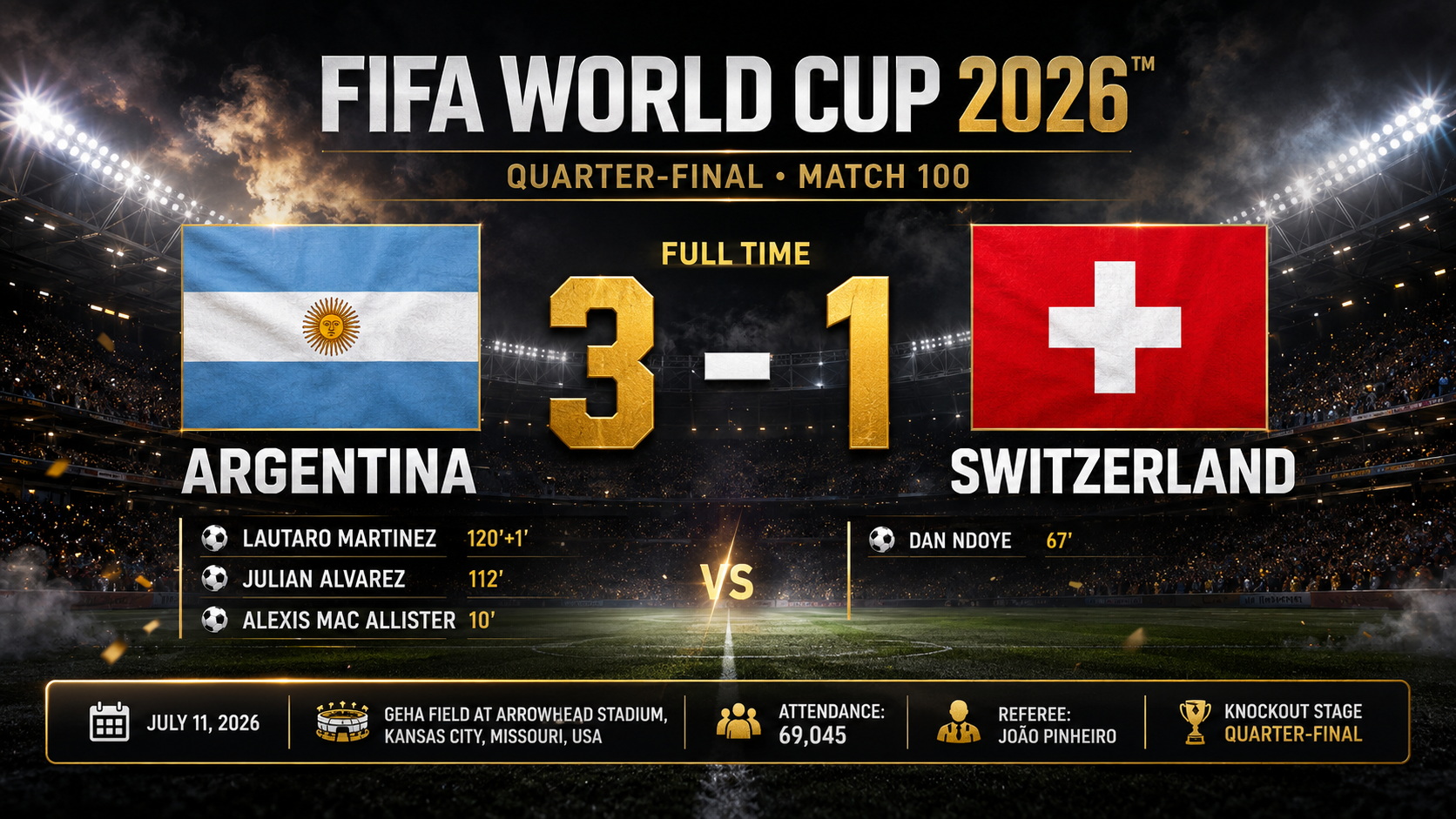
Quarter-final • Match 100 — Argentina 3–1 Switzerland after extra time
2026-07-11 • 21:00:00 • GEHA Field at Arrowhead, Kansas City, Missouri, USA • FIFA World Cup 2026
🇦🇷 Argentina 3–1 Switzerland 🇨🇭
After extra time — the night patience became power
FIFA World Cup 2026™ • Quarter-final • Match 100
GEHA Field at Arrowhead, Kansas City, Missouri
Attendance: 69,045
Referee: João Pinheiro
Goals: Alexis Mac Allister 10’, Dan Ndoye 67’, Julián Álvarez 112’, Lautaro Martínez 120+1’
Argentina reached the semifinal after a quarter-final that lasted more than two hours and demanded nearly every quality a tournament favorite is supposed to possess: control, patience, tactical flexibility, physical endurance and the nerve to remain calm when Switzerland turned the match into a test of survival.
The 3–1 scoreline looks comfortable from a distance.
It was anything but.
For 111 minutes, Switzerland stood level with Argentina. Then Julián Álvarez found the opening that changed the night, and Lautaro Martínez delivered the final blow as the Swiss chased an equalizer with nothing left to protect.
The account below is a journalistic reconstruction based on the supplied match timeline, lineups and confirmed result. Contemporary reporting also described Argentina’s greater depth and late tactical adjustments as decisive.
Before kickoff: Kansas City turns blue and white
Hours before the first whistle, the streets around the stadium had already become an Argentine gathering place.
Drums echoed through the parking areas. Blue-and-white shirts surrounded the entrances. Supporters sang for Lionel Messi, but the mood was not entirely relaxed. Switzerland had eliminated Colombia on penalties and arrived with the kind of defensive organization that can make even the most gifted attack feel trapped.
Kansas City’s fan festival and downtown viewing events drew large crowds ahead of the quarter-final, reflecting the scale of anticipation surrounding the city’s final World Cup match.
Argentina came to control the ball.
Switzerland came to control the spaces.
That distinction shaped almost everything that followed.
Starting lineups
Argentina — 4-1-3-2
Goalkeeper: Emiliano Martínez
Defenders: Nicolás Tagliafico, Lisandro Martínez, Cristian Romero, Nahuel Molina
Midfielders: Leandro Paredes, Rodrigo De Paul, Alexis Mac Allister, Enzo Fernández
Forwards: Julián Álvarez, Lionel Messi
Lionel Scaloni’s structure placed Paredes behind a narrow midfield line, with Messi free to leave the forward position and appear wherever Switzerland’s defensive block looked weakest.
Switzerland — 4-2-3-1
Goalkeeper: Gregor Kobel
Defenders: Nico Elvedi, Manuel Akanji, Ricardo Rodríguez
Midfielders: Denis Zakaria, Remo Freuler, Granit Xhaka, Djibril Sow, Fabian Rieder
Forwards: Breel Embolo, Dan Ndoye
Murat Yakin’s formation was flexible. Without the ball, Switzerland collapsed into a deep and narrow shape. In transition, Ndoye attacked the wide spaces while Embolo provided the physical reference point against Argentina’s center-backs.
First half
1’–9’ — Argentina take possession of the evening
João Pinheiro’s opening whistle released an immediate wave of Argentine pressure.
Paredes dropped between the center-backs to begin attacks. De Paul moved toward the right side to combine with Molina. Mac Allister occupied the left half-space, where he could receive facing Switzerland’s goal.
Messi did not remain beside Álvarez.
He drifted.
Sometimes he appeared behind Xhaka. Sometimes he moved toward the right touchline. Sometimes he walked away from the play entirely, waiting for Switzerland’s midfield to lose sight of him.
Switzerland stayed compact and refused to chase him recklessly.
For nine minutes, the match resembled a tactical negotiation.
Then Argentina accelerated.
10’ — Alexis Mac Allister makes it 1–0
The opening goal came from the type of movement Switzerland had spent the first minutes trying to prevent.
Argentina circulated possession patiently, drawing the Swiss midfield toward the ball. Messi dropped away from the front line and helped connect the attack. A passing lane appeared between midfield and defense.
Mac Allister attacked it.
He arrived from deeper territory, met the move before Switzerland could reset and finished beyond Gregor Kobel.
Argentina 1–0 Switzerland.
It was not simply a midfielder scoring.
It was the entire purpose of Argentina’s structure revealed in one sequence: Messi attracting attention, Álvarez occupying defenders and Mac Allister arriving unseen.
11’–25’ — Switzerland refuse to unravel
A lesser team might have abandoned its plan.
Switzerland did the opposite.
Xhaka demanded the ball. Freuler began moving closer to him, giving Switzerland cleaner exits from pressure. Ndoye stayed wide and high, forcing Tagliafico to hesitate before joining Argentina’s attacks.
Embolo battled Romero and Lisandro Martínez for every direct pass.
Argentina continued controlling possession, but Switzerland’s shape remained intact. Kobel dealt calmly with crosses, while Akanji stepped forward aggressively whenever Álvarez received with his back to goal.
The early strike had changed the score.
It had not broken the match.
26’–45’ — The Swiss block tightens
Argentina’s circulation became slower as the half progressed.
Paredes still found the ball, but Switzerland denied the next pass. Messi frequently received with two opponents nearby. Álvarez made repeated runs behind the defense, yet the timing of the final ball was slightly off.
At the other end, Ndoye produced Switzerland’s most dangerous moments. His acceleration forced Molina backward and gave Embolo opportunities to attack crosses.
Emiliano Martínez remained alert, especially when Switzerland targeted the space behind Argentina’s advanced fullbacks.
At halftime, Argentina led 1–0.
The score favored Scaloni.
The pattern still gave Yakin hope.
Second half
46’–60’ — Argentina search for control, Switzerland search for courage
Argentina restarted with greater urgency, aware that a one-goal advantage against this opponent offered very little comfort.
Enzo Fernández moved higher. De Paul pressed more aggressively after turnovers. Messi attempted to draw Xhaka and Zakaria out of their protective positions.
Switzerland survived.
Kobel’s presence gave the defensive line confidence. Akanji handled several dangerous situations, while Rodríguez used his experience to slow Argentina’s attacks near the left side of the penalty area.
Switzerland then began advancing five or ten meters higher.
That adjustment changed everything.
61’–66’ — The warning signs
Ndoye started finding room between Argentina’s fullback and center-back.
Xhaka switched play earlier.
Freuler and Sow competed for second balls rather than immediately retreating.
Argentina still had more possession, but the match was becoming less comfortable. Switzerland no longer looked like a team merely trying to stay alive.
They looked like a team preparing to strike.
67’ — Dan Ndoye equalizes
The goal came from Switzerland’s willingness to attack the space Argentina had left exposed.
A quick progression pulled the Argentine midfield toward one side. Switzerland moved the ball forward before Scaloni’s team could rebuild its defensive shape.
Ndoye attacked the open channel.
His pace took him beyond the first challenge, and his finish beat Emiliano Martínez.
Argentina 1–1 Switzerland.
The Swiss supporters erupted.
Argentina suddenly faced a completely different quarter-final.
The favorites had controlled the ball for long periods, but Switzerland had controlled the emotional moment.
68’–78’ — Argentina feel the pressure
For several minutes after the equalizer, Argentina looked unsettled.
Passes became hurried. Crosses arrived too early. Switzerland’s defenders celebrated blocks and clearances, drawing further energy from their supporters.
Messi began dropping even deeper, occasionally collecting possession near Paredes. His mission was no longer simply to create the final pass. It was to restore order.
Switzerland continued threatening on transitions. Embolo occupied Romero, while Ndoye’s movement remained Argentina’s greatest concern.
Scaloni prepared his bench.
78’–90’ — Fresh legs, no breakthrough
Argentina introduced attacking energy.
Nico González entered to stretch the field. Gonzalo Montiel added freshness at fullback. Lautaro Martínez replaced De Paul, transforming Argentina into a more aggressive attacking unit.
Switzerland responded with Miro Muheim, Silvan Widmer and Zeki Amdouni, reinforcing the wide areas and adding another counterattacking option.
The final minutes of regulation became frantic.
Argentina attacked.
Switzerland cleared.
Argentina recovered possession.
Switzerland compressed the box again.
Messi looked for the narrowest of passing lanes. Álvarez chased loose balls. Lautaro fought Akanji and Elvedi inside the area.
After ninety minutes, the score remained 1–1.
Extra time.
Extra time
91’–105’ — Switzerland’s resistance becomes heroic
Fatigue changed the geometry of the match.
Spaces appeared between midfield and defense, but players no longer possessed the same energy to exploit them. Argentina continued to dominate the ball, while Switzerland defended closer to Kobel.
Scaloni brought on Nicolás Otamendi, adding experience and allowing Argentina’s defenders to play more aggressively in Switzerland’s half.
Yakin introduced Ardon Jashari to refresh midfield.
Kobel remained composed.
Akanji continued organizing the defensive line.
Xhaka, exhausted but defiant, demanded that Switzerland hold its shape.
The first period of extra time ended with no winner.
Fifteen minutes remained.
106’–111’ — Argentina load the penalty area
Argentina’s shape now looked less like a traditional formation and more like a siege.
Messi operated behind the attack.
Álvarez moved across the defensive line.
Lautaro stayed central.
José Manuel López entered to provide another physical target, giving Switzerland one more striker to track.
That substitution mattered almost immediately.
112’ — Julián Álvarez restores Argentina’s lead
Argentina built again around the edge of Switzerland’s area.
José Manuel López received under pressure and helped move the ball into Álvarez’s path.
The forward reacted sharply.
One decisive touch created the shooting angle.
The finish beat Kobel.
Argentina 2–1 Switzerland.
The release around the stadium was enormous.
Álvarez sprinted toward the corner as the Argentine bench emptied behind him. Messi raised both arms. Scaloni turned toward his staff with clenched fists.
After more than 100 minutes of resistance, the Swiss wall had finally cracked.
113’–119’ — Switzerland gamble everything
There was no longer any reason for Switzerland to remain cautious.
Yakin pushed players forward. Ruben Vargas entered. Xhaka played earlier passes into the final third. Akanji advanced whenever possible.
Argentina now found open grass for counterattacks.
Messi nearly released Lautaro through the center. Kobel raced from his line. Switzerland recovered and attacked again.
Every clearance felt temporary.
Every Argentine break looked capable of ending the match.
120+1’ — Lautaro Martínez closes the door
Switzerland committed bodies forward for one final attack.
Argentina recovered possession.
The counterattack moved quickly into the exposed half.
Thiago Almada drove at goal and forced a save from Kobel, but the goalkeeper could not remove the danger completely.
Lautaro Martínez followed the play.
The rebound reached him.
He finished.
Argentina 3–1 Switzerland.
This time there was no way back.
The scoreline finally separated the teams, but it did not fully reflect how close Switzerland had been to carrying the match toward penalties.
Full time
João Pinheiro blew the final whistle.
Argentina’s players embraced in relief rather than wild celebration. They knew what Switzerland had demanded from them.
The Swiss players stood exhausted.
Kobel looked toward the scoreboard.
Xhaka gathered teammates near the center circle.
Their tournament was over, but their performance had forced one of the world’s most accomplished teams to reach the final minutes of extra time before securing victory.
Argentina advanced to face England in the semifinal. The official tournament path confirms that the quarter-final winner moved into that matchup.
Tactical analysis
Why Argentina eventually won
Argentina’s greatest advantage was not possession alone.
It was depth.
Scaloni could introduce Lautaro Martínez, Nico González, Thiago Almada, José Manuel López, Nicolás Otamendi and Montiel without abandoning the team’s identity.
As Switzerland tired, Argentina added more runners and more penalty-area presence. Reports following the match similarly highlighted Argentina’s tactical flexibility and bench strength as decisive factors.
Messi’s role was also vital even without appearing on the scoresheet. He repeatedly drew Swiss midfielders inward, creating spaces for Mac Allister, Álvarez and the substitutes to attack.
Why Switzerland remained competitive
Switzerland defended distances, not merely individuals.
Akanji and Elvedi protected the central zone. Xhaka and Freuler reduced the room available to Messi. Ndoye gave Argentina a constant reason to fear transitions.
Most importantly, Switzerland never allowed the opening goal to destroy their plan.
They remained patient until their equalizer arrived.
Their defeat came only after fatigue reduced the precision of their defensive movements and Argentina’s substitutes increased the pressure.
Player-by-player assessment
Argentina
Emiliano Martínez — 7/10
Could do little about Ndoye’s equalizer. Remained authoritative on crosses and communicated constantly with his defense.
Nahuel Molina — 6.5/10
Provided width but endured a difficult duel against Ndoye.
Cristian Romero — 7.5/10
Aggressive against Embolo and strong in direct confrontations.
Lisandro Martínez — 7.5/10
Progressed the ball well and stepped into midfield whenever Switzerland retreated.
Nicolás Tagliafico — 7/10
Disciplined and energetic, although Switzerland occasionally attacked the space behind him.
Leandro Paredes — 7.5/10
Controlled the early rhythm and gave Argentina a stable base.
Rodrigo De Paul — 7/10
Worked relentlessly and pressed well before making way for Lautaro.
Enzo Fernández — 7.5/10
Helped Argentina maintain pressure and covered large areas during transitions.
Alexis Mac Allister — 8.5/10
Scored the opener and repeatedly arrived in dangerous positions. One of Argentina’s most intelligent performers.
Lionel Messi — 8/10
Did not score, but shaped Switzerland’s defensive behavior. His positioning and passing kept Argentina’s attacks alive.
Julián Álvarez — 9/10
Constant movement, tireless pressing and the decisive extra-time goal.
Lautaro Martínez — 8/10
Entered from the bench and finished the match with the 120+1 goal.
José Manuel López — 7.5/10
Added a physical presence and contributed to Álvarez’s winner.
Thiago Almada — 7.5/10
His late burst and shot helped create Lautaro’s goal.
Nicolás Otamendi — 7/10
Provided experience during extra time.
Nico González — 7/10
Stretched Switzerland and created space for central attackers.
Gonzalo Montiel — 6.5/10
Fresh energy and positional discipline late in the match.
Switzerland
Gregor Kobel — 8/10
Made several important interventions and kept Switzerland level deep into extra time.
Nico Elvedi — 7.5/10
Strong positioning and brave defending under sustained pressure.
Manuel Akanji — 8.5/10
Switzerland’s defensive leader. Read attacks superbly and competed with Argentina’s forwards for nearly two hours.
Ricardo Rodríguez — 7/10
Used his experience well and helped control Switzerland’s left side.
Denis Zakaria — 7/10
Protected central areas and covered significant ground before being replaced.
Remo Freuler — 7.5/10
Disciplined, intelligent and essential to Switzerland’s compact midfield.
Granit Xhaka — 8/10
Switzerland’s organizer and emotional leader. Continued demanding the ball even as fatigue set in.
Djibril Sow — 6.5/10
Worked hard defensively and helped block Argentina’s passing lanes.
Fabian Rieder — 7/10
Added energy and competed aggressively around the midfield line.
Breel Embolo — 7/10
Occupied Argentina’s central defenders and provided an outlet during difficult periods.
Dan Ndoye — 8.5/10
Scored Switzerland’s equalizer and remained their most dangerous attacking threat.
Zeki Amdouni — 6.5/10
Offered fresh movement but received limited service.
Silvan Widmer — 6.5/10
Helped defend the wide areas during the closing stages.
Miro Muheim — 6.5/10
Entered during an intense period and competed with discipline.
Ardon Jashari — 6.5/10
Added midfield energy in extra time.
Ruben Vargas — 6.5/10
Entered when Switzerland needed a goal and tried to attack the open spaces.
Man of the Match
⭐ Julián Álvarez
Mac Allister opened the match.
Lautaro closed it.
Álvarez decided it.
His movement troubled Switzerland throughout the evening, and when the quarter-final reached its most exhausting, unforgiving stage, he produced the finish that sent Argentina into the semifinal.
Final verdict
Argentina won because they never confused frustration with failure.
Switzerland denied them space, disrupted their rhythm and equalized when the favorites appeared comfortable. For long periods, Argentina looked trapped inside a match designed by their opponent.
But Scaloni kept changing the picture.
More attackers.
Fresh midfield legs.
Greater penalty-area presence.
Eventually, Switzerland’s discipline met Argentina’s depth—and depth won.
Argentina 3–1 Switzerland after extra time.
A victory built not on one magical moment, but on persistence: Mac Allister at 10’, Ndoye’s answer at 67’, Álvarez’s breakthrough at 112’ and Lautaro’s final punctuation at 120+1’.
Next, you can tap Create the premium Match 100 banner, Generate Match 100’s full SQL update, or Make me a World Cup prediction bracket.
https://livesports.oiiq.net/index.php/match-home/100-quarter-final-match-100-argentina-3-1-switzerland